
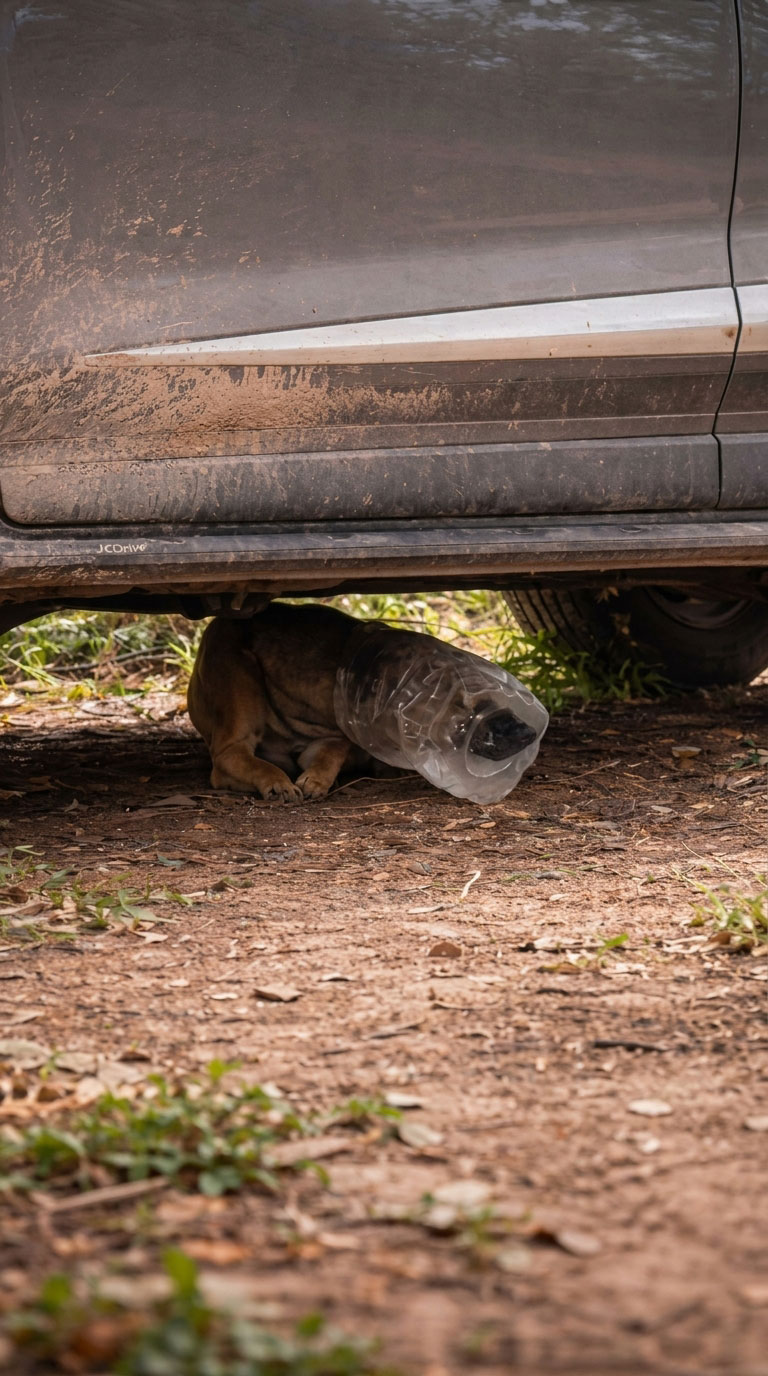
It is genuinely terrifying how fast a simple, harmless neighborhood stroll can turn into an absolute, life-threatening nightmare for an unsuspecting creature.
On a peaceful afternoon, a solitary stray dog wandered down a narrow street, his movements visibly erratic and his head tilted at an odd, unnaturally heavy angle. At first, casual passersby completely ignored him, simply assuming he was searching the ground for leftover scraps of food. But a closer look revealed a chilling reality that stopped everyone right in their tracks.
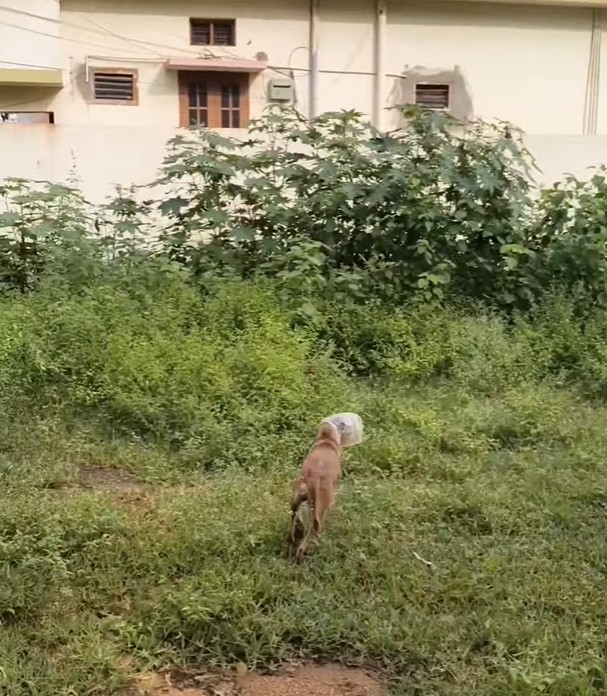
A thick, clear plastic jar was wedged tightly over his skull, entirely sealing off his eyes, nose, and mouth inside an airtight, suffocating dome. This triggered a tragic cycle of pure terror the exact moment his world suddenly went pitch black. He had most likely been hunting for the faint, enticing scent of leftover food when his head slipped inside the discarded container. In a split second, his entire universe vanished, substituted instead by the muffled, distorted sounds of a reality he could no longer see or navigate.
He wasn’t running because he was aggressive or wild; he was running because he was petrified, blindly slamming into fences and stumbling haphazardly through alleys. Every time a compassionate person tried to step closer to help, he perceived the movement as a terrifying, invisible threat closing in on him. He remained trapped in an exhausting, relentless cycle of panic, completely unaware that the very thing causing his terror was the plastic barrier trapped over his own face.
The Art of Patience: Watching And Waiting For The Right Moment
Our dedicated rescue team arrived on the scene promptly, but we knew better than to attempt a reckless, high-speed chase through the congested neighborhood. Instead, we maintained a significant distance, closely observing his trajectory and patiently waiting for his frantic energy to finally plateau. Forcing a confrontation right away would have only caused him to bolt into much greater danger, perhaps sprinting across a busy road or getting pinned hopelessly in a dark corner.
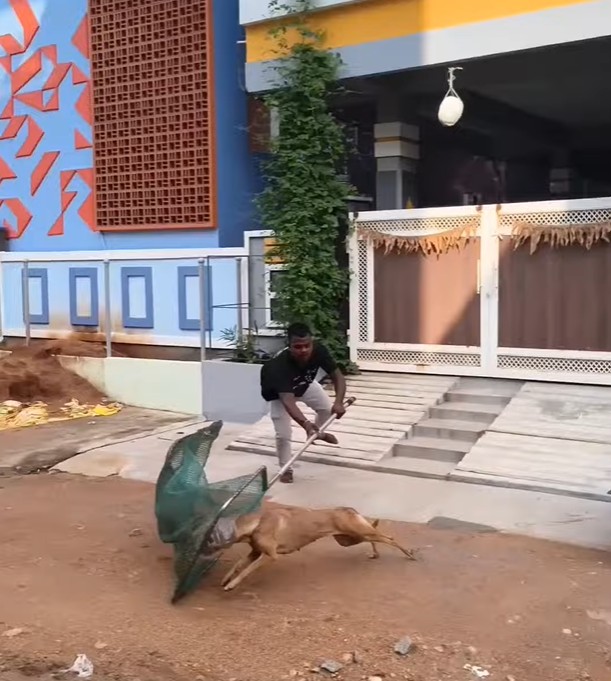
This situation was never a job for raw speed or loud commands; it required the cold, calculated patience of professionals who simply wanted to save a life safely. When he finally slowed down, leaning his weary, exhausted body against a low stone wall, we knew our window of opportunity had finally arrived.
A Precision Maneuver To Liberate A Soul From An Invisible Cage
We carefully coordinated our positions, silently deploying a large net to gently neutralize his erratic movements without causing any additional distress. The ultimate goal was never to trap him permanently, but rather to create a brief, calm space where his spiking heart rate could drop below the threshold of pure panic. With one rescuer holding the net firmly in place, another stepped forward equipped with a specialized cutting tool, working with the exact precision of a surgeon.
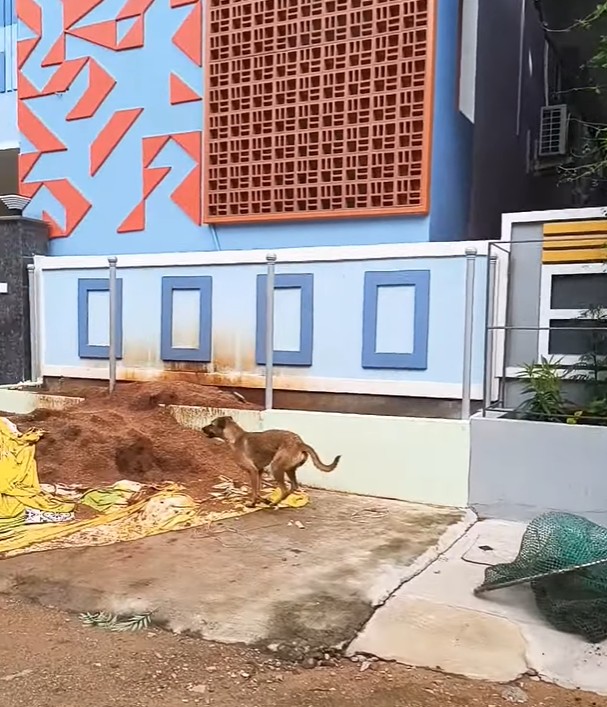
The blade moved slowly and deliberately, keeping the sharp edge inches away from his sensitive skin while methodically carving through the thick plastic. Then, the plastic finally gave way with a sharp, crisp snap, dropping down to the pavement as a discarded piece of trash. For the first time in hours, fresh, cool air flooded his nose, and the vibrant colors of the neighborhood rushed instantly back into his field of vision.
He didn’t pause to offer thanks or look back at his rescuers; he simply exploded into a sprint, finally moving with the purpose and clear awareness of a truly free animal. He vanished completely around the corner in mere seconds, leaving behind only the empty jar and a profound lesson regarding the hidden dangers of our daily waste.
Why Noticing The Invisible Threats Matters More Than We Think
That discarded plastic container was a completely harmless object to every human being who walked past it that day, yet it served as an absolute death sentence for a curious stray. It stands as a sobering reminder that danger rarely arrives with a warning label; often, it is hidden in the most mundane, overlooked pieces of debris.
Saving a life during desperate, high-stakes moments like this doesn't come down to sheer luck or perfect timing. It comes down to everyday people who choose to stop, who flatly refuse to turn a blind eye to the suffering of a creature they don’t even know. We managed to save his life by removing a piece of plastic, but he taught us that the most important thing we can do is simply look a little closer at the world around us.
Post a Comment